
Durability is important, but grade, certification, fire listing, function and production consistency answer different questions.
For: commercial hardware buyers, distributors, specifiers and private-label brands | Technical review: TOPTEK Access
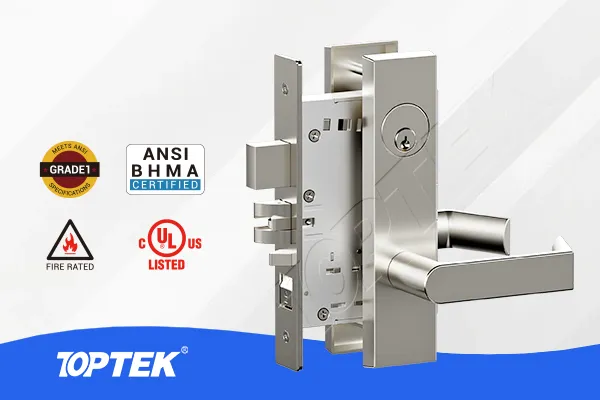
A heavy-duty mortise lock should be evaluated through a complete evidence package, not a single cycle number.
|
TL;DR ANSI/BHMA A156.13 covers operational, strength, security, cycle, finish and dimensional requirements. A supplier’s internal high-cycle result can add useful engineering evidence, but it is not the same as third-party certification. Fire-door listing is a separate check and must be verified for the exact model and function. |
The quick answer
A large cycle-test number is easy to compare, so it often dominates sales discussions. Yet a lock can cycle smoothly in a fixture and still be wrong for the opening, weak under an abuse load, incompatible with a strike, poorly protected by its finish or outside the claimed certification scope.
Use a layered review: standard and grade; certification status; exact function and model; fire listing where required; dimensional compatibility; and factory controls that keep production equivalent to the tested construction.
What the Grade 1 conversation should include
BHMA’s public A156.13 summary states that the standard includes operational tests, strength tests, security tests, cycle tests, finish tests and dimensional criteria. Grade 1 is therefore a performance category within a wider framework, not a synonym for one durability figure.
Buyers should ask which edition applies, which model and function were evaluated, who performed the test, whether the product is BHMA Certified, and how the certification can be checked. The answers should match the model marking, catalogue, packaging and quotation.
|
Evidence rule Keep third-party certification, fire listing and internal validation in separate lines of the submittal. Each supports a different claim. |
Internal validation is valuable when it is described honestly
A manufacturer may run additional durability, load, corrosion, dimensional or abuse tests during development and production. TOPTEK’s internal material describes extended cycle testing and high latch-load verification for its 9200-series platform. These results are useful for design margin and quality monitoring when the method, sample, acceptance limit and record are available.
They should be presented as internal verification unless a named accredited laboratory and applicable certificate say otherwise. This distinction improves credibility: the buyer can use the internal result as supporting engineering evidence without mistaking it for a certification mark.
Fire-door listing is a separate model check
Hardware used on a rated opening may need a fire-door listing such as UL 10C, depending on the project and jurisdiction. The listing should be checked for the exact lock model, function, trim or permitted configuration. A Grade 1 claim by itself does not establish fire suitability.
The reverse is also true. A fire listing does not automatically establish every Grade 1 requirement or every function. Put both requirements in the purchase specification and require evidence for each.
Production equivalence protects the approved performance
The performance of a submitted sample depends on materials, heat treatment, stamped geometry, machined tolerances, springs, fasteners, lubrication and assembly. For repeat orders, ask how these characteristics are controlled and what changes trigger revalidation.
A strong supplier can connect the certified or validated model to a bill-of-material revision, approved drawings, test fixtures, in-process records and traceable labels. That chain is what turns a good test result into dependable supply.
Five evidence layers for a commercial mortise lock
|
Layer |
Question it answers |
Verification route |
|---|---|---|
|
ANSI/BHMA grade |
What performance category applies? |
Applicable A156.13 edition and exact model/function |
|
BHMA certification |
Is third-party certification current? |
BHMA Certified Products Directory and product marking |
|
Fire listing |
Is the model listed for the rated opening? |
Listing database, label and permitted configuration |
|
Internal validation |
What additional design margin or QC data exists? |
Test method, sample size, acceptance limit and report |
|
Production control |
Will repeat orders match the approved construction? |
BOM/drawing revision, inspection plan and change control |
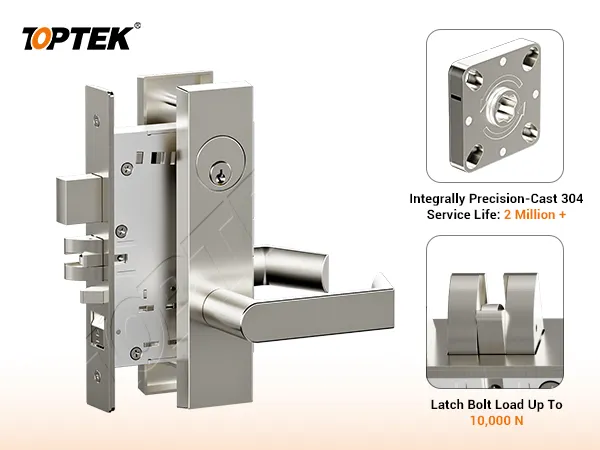
Example escutcheon-trim platform: grade, function, listing and exact configuration should be reviewed together.
Questions for the quotation and submittal
▪ Which ANSI/BHMA A156.13 edition, grade, model and function are claimed?
▪ Is the product BHMA Certified, and where can the current record be checked?
▪ Does the project require a fire listing, and is the exact configuration covered?
▪ Which tests are third-party and which are internal factory validation?
▪ Are strength, security, finish and dimensional requirements addressed—not cycles alone?
▪ What critical materials and components are controlled by specification?
▪ How are test fixtures calibrated and results traced to production lots?
▪ What design or supplier changes require customer notification and revalidation?
What a capable manufacturing partner should provide
TOPTEK publishes its ANSI Grade 1 mortise-lock models with function and listing information. Project teams should request the certificate or listing record for the exact model they intend to buy, particularly where fire-door use is scheduled.
The value of in-house machining and testing is consistency. TOPTEK’s manufacturing and verification capabilities can be translated into a customer-specific control plan covering drawings, critical parts, functional checks and retained records.
Frequently asked questions
Does two million internal cycles automatically mean ANSI Grade 1?
No. It may be useful supporting evidence, but Grade 1 must be established under the applicable A156.13 requirements and certification route.
Is every 9200-series function covered by the same fire listing?
Do not assume so. Verify the current listing and exact model/function configuration in the relevant database or certificate.
What should appear on a comparison sheet?
Separate rows for grade/certification, fire listing, function, materials, dimensions, internal validation and factory control.
|
Buyer takeaway Compare evidence layers, not advertising numbers. TOPTEK can provide model-level information for its ANSI mortise-lock range so your team can verify grade, function, listing and production controls before approval. |