
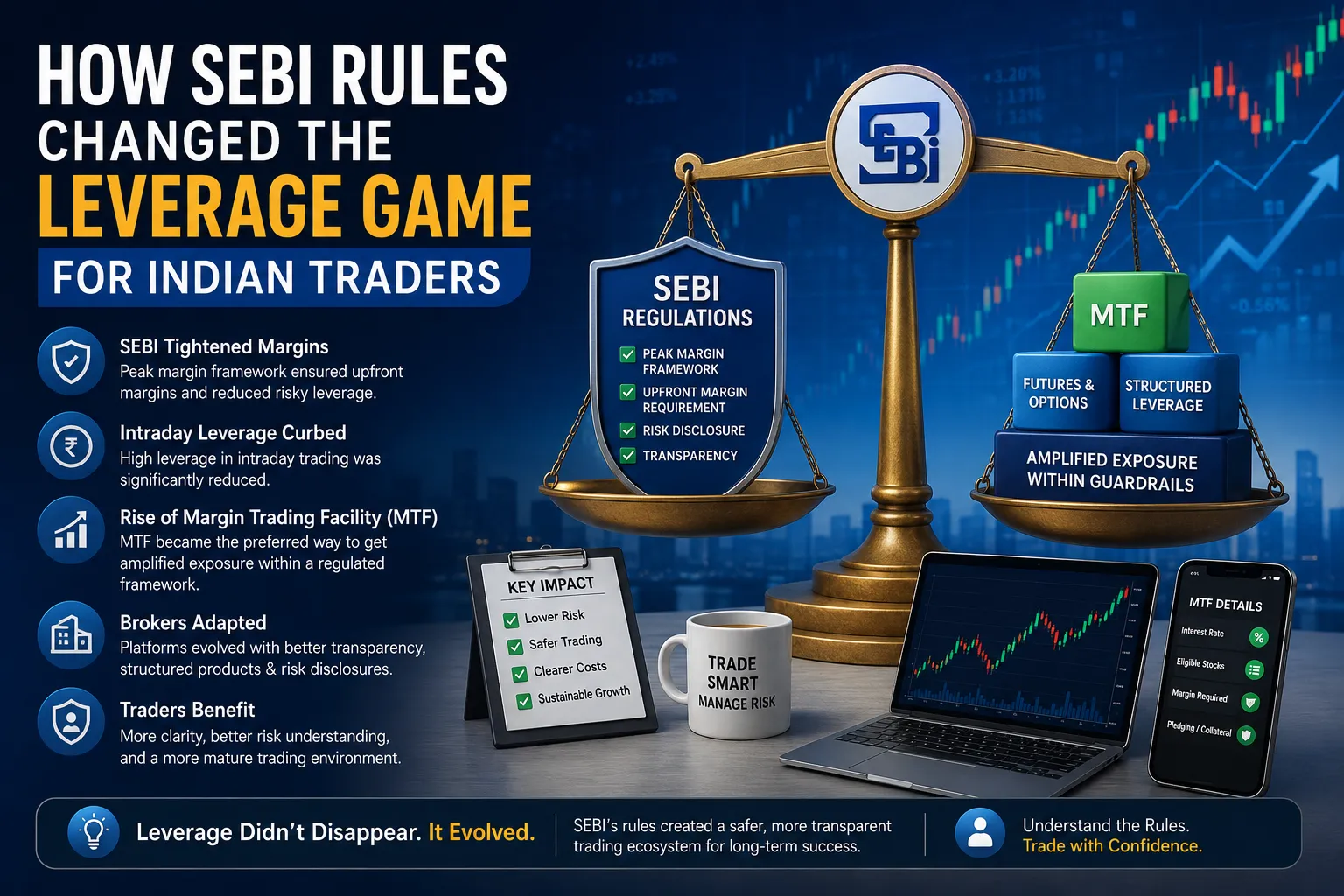
For years, leverage was the open secret of Indian retail trading. Brokers competed aggressively on the margins they offered, and traders grew accustomed to taking positions that were many times the size of their actual capital.
This was one of the biggest gaps that SEBI identified. This was the time when the entire system needed a rework. The search for the highest leverage broker in India, once a straightforward exercise, started producing very different answers.
Why SEBI Decided to Act
The Securities and Exchange Board of India did not act without reason. The regulator had been watching a familiar pattern play out across millions of retail accounts. Traders with limited capital were accessing leverage that amplified not just their profits but their losses at a scale that wiped out entire savings in a single session.
Intraday positions were being funded through informal broker arrangements that carried real systemic risk. The retail trader, drawn in by the promise of outsized returns, often had little understanding of how quickly the math could work against them. Something had to give.
This might sound simple to start with, but over time, this started to create problems that impacted the traders and the way they earn, which needed to change.
The Peak Margin Framework and What It Actually Changed
The peak margin framework, introduced in phases between 2020 and 2021, was the clearest signal that SEBI was drawing a hard line. Under the old system, brokers could allow traders to take intraday positions using margins far below what was technically required.
The new rules mandated upfront collection of peak margins, meaning traders had to have the actual required margin in their accounts before a position was opened, not just at the end of the day. The change effectively collapsed the intraday leverage ratios that had become standard across most discount brokers in India.
For traders who had built their strategies around high intraday leverage, this was not a minor inconvenience. A trader who could previously take a position worth ten lakhs with one lakh in capital suddenly found themselves needing significantly more skin in the game. Brokers had to adapt quickly, and the ones that could not rethink their model found themselves losing active traders to platforms that offered something more structured.
The Rise of Margin Trading Facility
Some brokers chose to restructure their entire offering around compliant products. Others began promoting Margin Trading Facility, or MTF, more aggressively than before. MTF had always existed as a regulated mechanism for funding stock purchases, but it gained new significance after the peak margin rules changed the calculus of intraday trading. Under MTF, a trader can buy stocks in the cash segment beyond their available cash, with the broker funding the shortfall at an agreed interest rate. The position can be carried forward, which makes it genuinely useful for traders who want exposure without the overnight gap risk of futures.
The push toward MTF also reflected a broader shift in how brokers were thinking about their product mix. Intraday leverage in equities was now tightly regulated, but MTF offered a legitimate route to amplified exposure within a structured, SEBI-approved framework. The race to find the lowest mtf interest rate broker became meaningful in a way it had not been before, because traders were now comparing interest rates, eligible stock lists, and pledging mechanics rather than simply chasing the biggest multiplier.
How the Broker Landscape Responded
Among the brokers that navigated this transition well, Pocketful emerged as a notable name for traders looking at both compliant leverage access and MTF functionality. Its platform was built with the post-SEBI regulatory framework in mind, offering MTF at competitive rates with a clean interface that made it easier for traders to understand their actual exposure and the cost of maintaining it. For traders re-entering the market after the margin rule changes, that kind of structural clarity mattered more than it ever had.
Other platforms responded differently. Some doubled down on futures and options education, helping their user base shift from leveraged intraday equity trades to F&O strategies. Others simplified their margin dashboards. This helped traders to see the actual risk they were taking. This was aimed at promoting transparency. This was something the pre-regulation environment had rarely prioritized.
F&O Traders Felt It Too
The F&O segment also saw consequences, though they played out differently. SEBI had long been concerned about retail participation in options, particularly the scale of losses being absorbed by inexperienced traders chasing weekly expiry premiums. Circulars requiring brokers to display risk disclosures prominently, followed by further proposals around lot sizes and eligibility criteria for F&O trading, reflected the same underlying philosophy. Regulation was not trying to remove access entirely but to make sure the access came with comprehension attached.
What the new framework revealed was something the industry had perhaps always known. The demand for leverage among retail traders is real and persistent. It does not go away when rules change. It finds a new shape. The shift from unregulated intraday amplification to MTF and compliant futures positions is essentially the same demand flowing through a different pipe, one that SEBI designed with guardrails.
Conclusion
What SEBI essentially did was force a maturity event on the market. Leverage did not disappear. It was redirected through channels that carried clearer disclosures, collateral requirements, and overnight risk understanding.
The trader who uses MTF today knows the cost of carrying that position because it shows up as a daily interest charge. That transparency was largely absent in the old intraday leverage model, where the real cost of being wrong was often only understood after it had already happened.
For traders, the practical lesson has been to understand those guardrails rather than resent them. The broker landscape has evolved to focus more on compliance, and the traders who have adapted are generally operating with more clarity about their actual risk than they had before.
